
Administrative Law is an important branch of Public Law that deals with the powers, functions, and responsibilities of government authorities. It ensures that administrative authorities exercise their powers fairly, legally, and responsibly while performing their duties.
As the role and functions of government have increased in modern society, Administrative Law has become increasingly important. It helps to prevent the misuse of administrative power, protects the rights of citizens, and promotes fairness, accountability, and good governance.
In this article, you will learn about the meaning, nature, scope, sources, historical evolution, theories, and constitutional relationship of Administrative Law in a simple and easy-to-understand manner.
Introduction to Administrative Law
The word Administration comes from the Latin word “administrare”, which means “to manage, to serve, or to carry out.”
- Ad = to / toward
- Ministrare = to serve or manage
Thus, Administration generally means the management or carrying out of public affairs.
Administrative Law is an important branch of Public Law. It deals with the organisation, powers, functions, duties, and procedures of administrative authorities. It also regulates the exercise of administrative power and ensures that public authorities act within the limits of law, fairly, reasonably, and in accordance with the principles of natural justice.
The importance of Administrative Law has increased with the development of the modern Welfare State. Earlier, under the Laissez-faire State, the role of government was mainly limited to maintaining law and order and protecting the country. However, with the development of the Welfare State, the government began to perform wider functions relating to education, public health, taxation, social security, environmental protection, economic regulation, and public welfare.
As the functions of the government increased, the powers and responsibilities of administrative authorities also expanded. This created a need for legal rules to control administrative power and protect the rights and interests of individuals. Administrative Law provides this legal framework.
Definition of Administrative Law
Definition by A. C. Dicey –
According to Dicey “Administrative Law is –
that portion of nation’s legal system which determines the legal status and liabilities of the state officials;
that which defines the rights and liabilities of private individuals in their dealings with the public officials;
that which specifies the procedure by which these rights and liabilities are enforced”.
Definition by Ivor Jennings –
According to Ivor Jennings, “Administrative Law is the law relating to the administration. It determines the organization, powers and duties of the administrative authorities”.
Definition by Wade – According to Wade “Administrative Law is the law relating to the control of the governmental power“.
Definition by K. C. Davis – According to K. C. Davis, “Administrative Law is the law concerning the powers and procedures of administrative agencies, including especially the law governing judicial review of administrative action”.
Definition by Garner – Garner has also adopted the American approach as advocated by K. C. Davis. According to Garner, Administrative Law may be described as “those rules which are recognized by the courts as law and which relate to and regulate the administration of Government”.
Definition by Jain and Jain – According to Jain and Jain “Administrative Law deals with the structure, powers and functions of the organs of administration, the limits of their powers, the methods and procedures followed by them in exercising their powers and functions, the methods by which their powers are controlled including the legal remedies available to a person against them when his rights are infringed by their operation”.
Nature of Administrative Law
1. Branch of Public Law
Administrative Law is an important branch of Public Law. It regulates the relationship between the State and citizens. It deals with government departments, administrative authorities, tribunals and public officials. Its main purpose is to regulate the exercise of public power rather than private disputes.
2. Procedural Law with Substantive Elements
Administrative Law mainly deals with the procedure to be followed by administrative authorities while exercising their powers and making decisions. It also contains some substantive rules regarding the powers, duties and functions of administrative authorities. It ensures that administrative authorities follow a fair and lawful procedure.
3. Control over Discretionary Powers
Modern government authorities have many discretionary powers, which means they have some freedom to choose between different lawful options. Administrative Law does not completely remove this discretion. Instead, it ensures that such powers are not abused, misused, or exercised arbitrarily.
4. Mainly Uncodified and Judge-Made Law
Administrative Law is largely uncodified, meaning there is no single comprehensive code containing all its rules. It has developed through judicial decisions, case laws, statutes, constitutional provisions and judicial review. Courts control administrative action through remedies such as Mandamus, Certiorari, Prohibition, Quo Warranto and Habeas Corpus.
5. Concerned with Administrative Authorities
Administrative Law deals with the organisation, powers, functions and duties of administrative authorities. It also determines the limits within which these authorities must exercise their powers.
6. Based on Principles of Natural Justice
Administrative Law gives importance to fairness in administrative decision-making. It incorporates the principles of natural justice, such as:
- Nemo judex in causa sua – No one should be a judge in their own case; this is the rule against bias.
- Audi alteram partem – Hear the other side; it provides the right to a fair hearing.
- Reasoned Decision – The authority should give proper reasons for its decision, where required.
7. Closely Related to Constitutional Law
Administrative Law is closely connected with Constitutional Law. Constitutional Law deals with the basic structure of the State and the powers of the Legislature, Executive and Judiciary. Administrative Law mainly deals with the actual exercise of executive and administrative powers and controls administrative authorities.
8. Subject to Judicial Review
Administrative authorities are not completely free to exercise their powers. Their actions can be examined by courts through judicial review. Courts may interfere when an authority acts illegally, arbitrarily, unreasonably, beyond its powers, or in violation of principles of natural justice.
9. Protects Individual Rights
Administrative Law protects citizens from arbitrary, unreasonable and unlawful actions of government authorities. It ensures that administrative authorities exercise their powers according to law.
10. Provides Effective Legal Remedies
Administrative Law provides various remedies to persons affected by unlawful administrative action. These may include writs, judicial review, damages, injunctions and remedies before administrative tribunals, depending upon the circumstances.
11. Dynamic and Developing Branch of Law
Administrative Law is a dynamic and developing branch of law. As the functions of the modern Welfare State increase, administrative authorities receive more responsibilities and powers. Therefore, Administrative Law continues to develop through legislation and judicial decisions.
12. Ensures Accountability and Good Governance
Administrative Law makes public authorities accountable for their actions. It promotes fairness, transparency, reasonableness, legality and good governance.
Scope of Administrative Law
The scope of Administrative Law means the areas and matters covered by Administrative Law. As the functions of the modern Welfare State have increased, the scope of Administrative Law has also become very wide.
1. Administrative Bodies and Authorities
Administrative Law covers various administrative bodies and authorities that perform governmental and public functions. These authorities may exercise: Administrative powers; Judicial powers; or Quasi-judicial powers. Administrative Law determines their organisation, powers, functions and duties and ensures that they act within the authority given to them by law. For example, government departments and statutory authorities may have the power to grant licences, issue orders, regulate industries or implement welfare schemes. Their actions are controlled by Administrative Law.
2. Powers and Functions of Administrative Authorities
A major part of Administrative Law is concerned with the powers and functions of administrative authorities. It determines:
- What powers an authority possesses;
- How those powers should be exercised;
- What duties the authority has; and
- What limitations are imposed on those powers.
An administrative authority cannot exercise powers merely because it considers them necessary. Its power must have a legal basis. Thus, Administrative Law ensures that administrative authorities remain within the limits prescribed by law.
3. Administrative Discretion
Administrative authorities are often given discretionary powers because every possible situation cannot be dealt with by detailed legislation. For example, an authority may have discretion to grant or refuse a licence after considering certain conditions. Administrative Law does not completely remove such discretion. Instead, it controls the manner in which discretion is exercised.
Discretion must not be:
- Arbitrary;
- Unreasonable;
- Mala fide;
- Based on irrelevant considerations; or
- Used for an improper purpose.
Therefore, Administrative Law ensures that discretionary power does not become arbitrary power.
4. Administrative Tribunals
Administrative Law includes Administrative Tribunals, which are specialised bodies created to decide particular types of disputes.
Examples include:
- Central Administrative Tribunal (CAT)
- Maharashtra Administrative Tribunal (MAT)
- Other specialised tribunals dealing with taxation, industrial disputes, service matters, etc.
Tribunals generally provide specialised and comparatively speedy mechanisms for deciding disputes. Administrative Law regulates their jurisdiction, procedure, powers and control.
5. Administrative Boards and Commissions
The scope of Administrative Law also includes various administrative boards and commissions.
Examples mentioned in your book include:
- Wage Boards;
- Advisory Boards;
- Board of Revenue;
- Inquiry Commissions; and
- Tariff Commissions.
Such bodies perform specialised administrative or quasi-judicial functions. Administrative Law regulates their powers and procedures.
6. Delegated Legislation
Delegated Legislation is an important part of Administrative Law. The Legislature makes the main law but may delegate limited powers to the Executive or administrative authorities to make detailed rules and regulations. For example, an Act may provide the general framework, while the concerned authority makes detailed rules, regulations, notifications or bye-laws for implementing the Act.
Administrative Law controls delegated legislation by ensuring that the administrative authority:
- Acts within the power delegated by the Legislature;
- Does not exceed its authority; and
- Follows the requirements of the parent Act.
If an authority makes rules beyond the power given to it, those rules may be declared ultra vires.
7. Principles of Natural Justice
The scope of Administrative Law includes the principles of Natural Justice, which are important for ensuring fairness in administrative decision-making.
The two main principles are:
Audi alteram partem – It means “hear the other side.” A person whose rights or interests may be affected should generally be given a fair opportunity to present their case.
Nemo judex in causa sua – It means “no one should be a judge in their own cause.” It prevents a person with a conflict of interest or bias from deciding the matter.
Administrative authorities may also be required to give reasons for their decisions, particularly where the law or circumstances require a reasoned decision.
8. Control of Administrative Power
One of the most important purposes of Administrative Law is to control administrative power. Administrative authorities have wide powers, but those powers cannot be exercised without legal limitations.
Control helps prevent:
- Abuse of power;
- Misuse of power;
- Arbitrary action;
- Excess of jurisdiction; and
- Unreasonable administrative decisions.
Control may be exercised through legislative, judicial and administrative mechanisms.
9. Lokayukta and Up-Lokayukta
The scope of Administrative Law may also include institutions such as the Lokayukta and Up-Lokayukta, depending on the applicable statutory framework. These institutions deal with complaints concerning corruption, improper conduct or maladministration by public officials. They help promote accountability and integrity in public administration.
10. Government Liability
Administrative Law also deals with the liability of the Government and public authorities. When government authorities perform administrative functions, questions may arise about whether the Government or a public authority can be held legally responsible for injury, loss or unlawful action. Administrative Law therefore considers the circumstances in which the State or public authority may incur legal liability.
11. Judicial Review
Judicial Review is a very important part of the scope of Administrative Law. It allows courts to examine the legality of administrative action.
The court may examine whether:
- The authority had legal power to act;
- It acted within its jurisdiction;
- It followed the required procedure;
- It observed principles of natural justice;
- It acted reasonably; and
- It complied with constitutional and legal requirements.
Judicial review therefore acts as an important safeguard against unlawful or arbitrary administrative action.
12. Licences, Permits and Administrative Orders
Administrative authorities perform many functions such as:
- Granting licences;
- Issuing permits;
- Cancelling licences;
- Issuing administrative orders; and
- Making rules for the implementation of laws.
Administrative Law regulates how these powers are exercised.
For example, if an authority has the legal power to cancel a licence, it may still have to follow the required procedure and principles of fairness before cancelling it.
13. Service Rules and Public Servants
Administrative Law also covers matters relating to government employees and public servants.
These may include:
- Recruitment;
- Appointment;
- Promotion;
- Transfer;
- Suspension;
- Disciplinary proceedings;
- Dismissal; and
- Other conditions of service.
Where disciplinary action affects the rights of a public servant, principles of natural justice and fair procedure may become important.
14. Protection of Individual Rights
An important objective of Administrative Law is the protection of individual rights against unlawful administrative action. Since administrative authorities exercise considerable power, individuals need legal protection against arbitrary decisions. Administrative Law provides mechanisms through which affected persons can challenge unlawful administrative action and seek appropriate remedies.
Evolution of Administrative Law
The evolution of Administrative Law is closely connected with the changing role of the State. The powers and functions of government were not always as wide as they are today. In the beginning, the State had limited functions. With the development of the Laissez-faire State, and later the Welfare State, government activities increased considerably. This expansion of governmental functions resulted in the growth and development of Administrative Law.
Administrative Law developed as a means of controlling administrative power, ensuring lawful administration, and protecting individual rights.
Laissez-faire State to Welfare State
The concept of the State has undergone a significant change from the Laissez-faire State to the Social Welfare State. In the earlier period, the State had limited functions and mainly concentrated on maintaining law and order, defence and administration. With the development of modern society, the needs and expectations of people increased, and consequently the functions of the State also expanded.
1. Meaning of Laissez-faire State
The term Laissez-faire means “leave alone” or “let people do what they want.” Under this concept, the State followed a negative or limited role. The government did not interfere much in the economic and social activities of individuals.
The State was mainly concerned with essential functions such as:
- Maintenance of law and order;
- Protection of the country;
- Defence;
- Administration; and
- Protection of property and individual freedom.
The management of social and economic life was largely not regarded as the responsibility of the government. The Laissez-faire approach therefore gave greater importance to individual freedom and private interests.
The Era of the Laissez-Faire State
During the 18th and 19th centuries, dominant political and economic theory (influenced by thinkers like Adam Smith and John Locke) favored individual liberty, free enterprise, and minimal state intervention.
Role of the State: The state acted purely as a “night-watchman” or police state. Its primary functions were restricted to:
Maintaining external defense against foreign aggression.
Preserving domestic law and order.
Administering basic civil and criminal justice.
Collecting basic taxes to fund these bare minimums.
Status of Administrative Law: Administrative law had minimal scope because public authorities exercised very few discretionary powers over private citizens. Ordinary courts and private law rules were sufficient to govern human interactions, as the government rarely intervened in socio-economic matters.
Catalysts for Transition
The unbridled free market led to severe market failures, exploitation, and socio-economic distress:
Industrial Revolution: Rapid urban migration, unsafe working conditions, child labor, and low wages created deep social inequalities.
Monopolistic Abuses: Unchecked capitalism led to cartels, unsafe consumer products, and exploitation of vulnerable classes.
Economic Crises & Wars: The Great Depression (1930s) and the aftermath of the World Wars demonstrated that free markets could not self-regulate effectively in crises, necessitating centralized economic planning and public relief.
Reasons For The Growth Of Administrative Law
1) Change in the Role of the State
The role of the State has changed greatly in modern times. Earlier, the State mainly performed the function of maintaining law and order and protecting people from external and internal threats. This was known as the Police State. Today, the State has become a Welfare State. It works for the social and economic welfare of the people. The government performs many functions such as providing public health, education, social security, employment opportunities, regulating industries, improving slums, protecting public morals and promoting social justice. Because the functions of the government have increased, the scope and importance of Administrative Law have also increased. Today, people expect the government not only to protect them but also to improve their standard of living and ensure their overall well-being.
2) Flexibility
Flexibility is an important reason for the growth of Administrative Law. Administrative rules are more flexible than laws made by the Legislature. Administrative authorities can change, modify or remove a rule when it is found to be unsuitable or defective. On the other hand, laws made by the Legislature are comparatively rigid. Changing a law usually requires following the legislative procedure, which may take considerable time. Therefore, the administrative process is preferred because it can quickly adjust to changing circumstances and needs.
3) Scope for Experiment
Administrative Law provides a wide scope for experimentation. Administrative authorities can introduce new rules and preventive measures according to the needs of society. For example, authorities can regulate activities through licensing, rate-fixing, inspection and other preventive measures. They do not always have to wait until a person violates the law or a dispute comes before a court. For example, inspection and grading of food or meat can prevent consumers from being harmed. Similarly, an authority may suspend, cancel or revoke a licence or destroy contaminated articles when necessary. Thus, administrative authorities can take quick preventive and practical measures, which makes Administrative Law more effective in many situations.
4) Modern Legislatures are Overburdened with Work
Modern Legislatures have a very large amount of work. They have to deal with many social, economic, political and technical matters. It is not possible for the Legislature to make detailed rules for every small matter. Therefore, some legislative powers are delegated to administrative authorities. Administrative authorities can then make detailed rules, regulations and orders according to the requirements of a particular situation. Thus, the heavy workload of modern Legislatures has contributed greatly to the growth of Administrative Law.
5) Legislative Process is Inadequate
The legislative process is sometimes inadequate to deal with the technical and complex problems of modern society. Legislators may have political and law- making knowledge, but they cannot always have expert knowledge of every technical subject. Administrative departments, on the other hand, often have specialised and technical experts. Therefore, some powers are delegated to administrative authorities so that they can make suitable rules with the help of their specialised knowledge and experience. This need for technical expertise has become an important reason for the growth and development of Administrative Law.
6) Inadequacy of Judicial System
The ordinary courts are often overburdened with a large number of cases. As a result, cases may take a long time to be decided and litigation can also be expensive. Moreover, some modern disputes require specialised and technical knowledge which ordinary courts may not always possess. Therefore, special bodies such as Industrial Tribunals, Labour Courts and Administrative Tribunals were established to deal with particular types of disputes. For example, disputes between employers and employees, strikes and lockouts can be dealt with by Industrial Tribunals and Labour Courts. Similarly, service-related disputes of government employees can be dealt with by Administrative Tribunals. These bodies have specialised knowledge and can provide faster and more practical solutions. Thus, the limitations of the ordinary judicial system have contributed to the development of Administrative Law.
7) Fast and Functional Approach
Another important reason for the growth of Administrative Law is its fast and functional approach. Administrative authorities and tribunals are generally not required to follow all the formal and technical procedures followed by ordinary courts. Ordinary courts have to follow detailed rules of evidence and procedure. Administrative Tribunals can adopt a more practical and flexible approach while deciding cases. This helps them deal with complex matters and provide decisions more quickly. Therefore, the speed, flexibility and practical approach of administrative authorities and tribunals have contributed to the rapid growth and development of Administrative Law
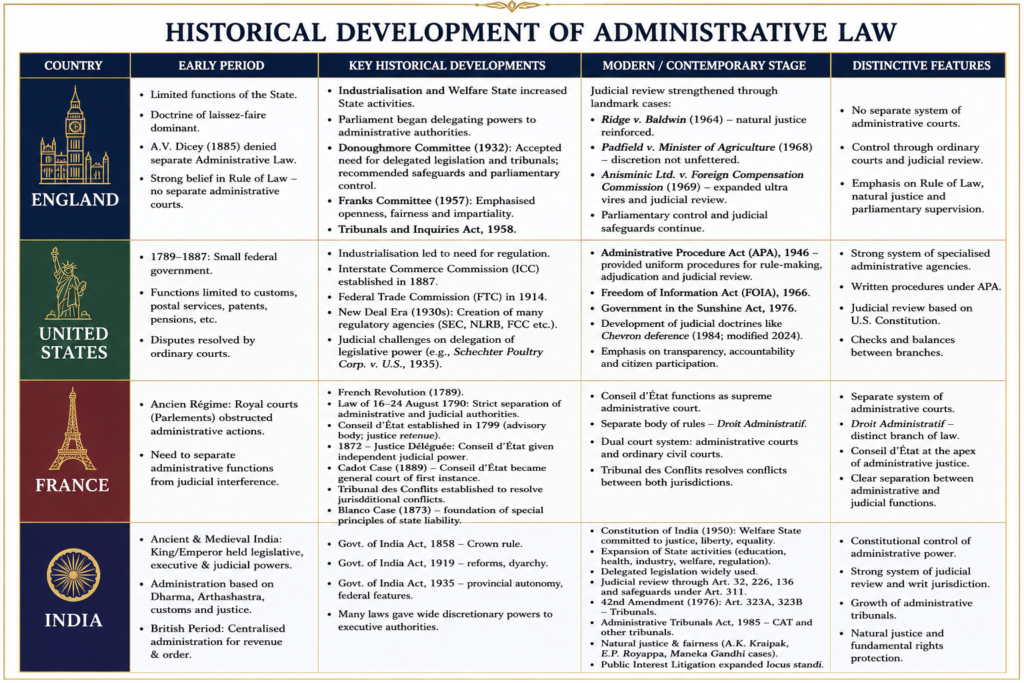
Historical Development of Administrative Law
Administrative Law has developed gradually with the expansion of the functions of the modern State. Earlier, the State mainly performed limited functions such as maintaining law and order, defence and administration of justice. With industrialisation, urbanisation, economic development and the emergence of the Welfare State, governmental activities increased considerably. As a result, administrative authorities were given wider powers to make rules, issue orders, grant licences, regulate industries and decide disputes.
The historical development of Administrative Law is different in England, the United States, France and India.
1. Historical Development of Administrative Law in England
England played an important role in the development of modern Administrative Law. However, its development was comparatively slow because of the traditional English belief in the Rule of Law and the idea that there should be no separate system of administrative courts.
A. Early Development
In the early period, the functions of the State were limited. The government mainly concentrated on maintaining law and order, defence, collection of revenue and administration of justice. The doctrine of laissez-faire was influential. It meant that the State should interfere as little as possible in the economic and private activities of individuals. Therefore, there was comparatively little need for Administrative Law.
B. Dicey’s Denial of Administrative Law
A major reason for the delayed recognition of Administrative Law in England was the theory of A.V. Dicey. In his famous work Introduction to the Study of the Law of the Constitution (1885), Dicey strongly emphasised the Rule of Law. According to Dicey, the Rule of Law meant, among other things:
- No person should be punished except for a breach of law established through the ordinary legal process.
- All persons are subject to the ordinary law administered by ordinary courts.
- The rights of individuals are protected by ordinary courts.
Dicey criticised the French system of Droit Administratif, particularly the existence of separate administrative courts. He believed that England did not have, and should not have, a separate system of Administrative Law. Thus, Dicey’s theory initially delayed the recognition of Administrative Law as a distinct subject in England.
C. Impact of Industrialisation and Welfare State
Despite Dicey’s theory, the Industrial Revolution brought significant social and economic changes. Industrialisation resulted in problems such as: Poor working conditions, Child labour, Low wages, Unemployment, Industrial disputes ,Poor housing, Public health problems, Exploitation of workers ETC. The government could no longer remain a passive or minimal State. It began to adopt welfare measures and regulate various economic and social activities. As governmental functions increased, Parliament started delegating powers to: Government departments, Administrative boards, Local authorities, Public bodies, Administrative tribunals ETC. This resulted in the growth of delegated legislation and administrative adjudication.
D. Growth of Delegated Legislation
Modern Parliament could not make detailed rules for every matter because of its heavy workload and the technical nature of modern administration. Therefore, Parliament delegated certain rule-making powers to administrative authorities. These authorities could make: Rules, Regulations, Orders, Bye-laws, Schemes ETC. Delegated legislation therefore became an important feature of English Administrative Law.
E. Donoughmore Committee, 1932
The growth of delegated legislation and administrative powers raised concerns about excessive executive power. Lord Hewart criticised this development in his book The New Despotism (1929). In response, the Committee on Ministers’ Powers, commonly known as the Donoughmore Committee, was appointed. It submitted its report in 1932. The Committee accepted that delegated legislation and administrative tribunals were necessary in a modern State. However, it also recommended safeguards such as: Parliamentary supervision, Proper limits on delegated powers, Judicial safeguards, Greater control over administrative authorities ETC.Thus, the Committee did not recommend abolition of administrative powers but supported their controlled and responsible use.
F. Franks Committee, 1957
The Franks Committee was appointed in 1957 to examine administrative tribunals and inquiries. It emphasised three important principles: Openness, Fairness, Impartiality ETC. The Committee’s recommendations contributed to the development of better procedures for administrative tribunals and inquiries and led to the Tribunals and Inquiries Act, 1958.
G. Modern Judicial Development
English courts have played a major role in controlling administrative authorities through judicial review.
1. Ridge v. Baldwin (1964)
This case is an important landmark in the development of natural justice. The decision strengthened the principle that a person should be given a fair opportunity to be heard before an administrative decision adversely affecting his rights is made.
2. Padfield v. Minister of Agriculture (1968)
The House of Lords held that discretionary powers given to an administrative authority are not unlimited. Administrative discretion must be exercised according to the purpose and policy of the law. Thus, the case strengthened judicial control over administrative discretion.
2. Historical Development of Administrative Law in the United States
The development of Administrative Law in the United States is closely connected with the separation of powers, checks and balances, industrialisation and the growth of regulatory agencies. Unlike England, the United States has a written Constitution and a federal system.
A. Early Period: 1789–1887
During the early period, the Federal Government was comparatively small. Administrative functions were mainly related to: Customs ,Postal services ,Patents ,Pensions, Revenue administration etc .Disputes were generally dealt with by ordinary courts using traditional legal remedies. There was therefore no large administrative State during this period.
B. Rise of Regulatory Agencies
Rapid Industrialisation during the nineteenth century led to the growth of large corporations, railways and monopolies. These developments created problems such as: Unfair business practices, Monopoly Unreasonable railway rates , Exploitation of consumers Lack of economic regulation etc. The government therefore began creating Specialised administrative agencies.
C. Interstate Commerce Commission, 1887
A major landmark was the establishment of the Interstate Commerce Commission (ICC) in 1887. The ICC was created to regulate interstate railway activities and prevent unfair practices. It is generally regarded as an important milestone in the development of modern American administrative agencies.
D. Further Growth of Agencies
The number of regulatory agencies increased with the growth of the economy. For example, the Federal Trade Commission (FTC) was established in 1914 to deal with unfair methods of competition and certain unfair business practices. Administrative agencies were given powers to: Make regulations, Investigate violations, Conduct hearings, Issue orders, Enforce regulatory laws ETC. Thus, administrative agencies became an important part of the American governmental system.
E. New Deal Era of the 1930s
The Great Depression created serious economic and social problems in the United States. President Franklin D. Roosevelt introduced the New Deal programmes to deal with the economic crisis. During this period, the Federal Government greatly expanded its activities and several administrative agencies were created or strengthened. Important agencies included bodies such as:
- Securities and Exchange Commission (SEC)
- National Labor Relations Board (NLRB)
- Federal Communications Commission (FCC)
This resulted in a significant expansion of administrative power.
F. Judicial Challenges
The expansion of administrative power also raised constitutional questions, particularly concerning the separation of powers and delegation of legislative power. In Schechter Poultry Corp. v. United States (1935), the Supreme Court invalidated provisions of the National Industrial Recovery Act, raising important issues concerning excessive delegation of legislative power. This demonstrated that administrative power in the United States is subject to constitutional limitations.
G. Administrative Procedure Act, 1946
One of the most important developments in American Administrative Law was the enactment of the Administrative Procedure Act (APA), 1946. The APA established a general procedural framework for federal administrative agencies. It dealt with matters such as: Administrative rule-making, Notice and comment procedures, Administrative adjudication, Agency procedures, Judicial review of administrative action ETC. The Act attempted to maintain a balance between effective administration and protection of individual rights.
H. Modern Development
In the modern period, greater emphasis has been placed on: Transparency, Accountability, Public participation, Judicial review, Protection of individual rights ETC. The Freedom of Information Act (FOIA), 1966 promoted access to government information. The Government in the Sunshine Act, 1976 promoted openness in certain government proceedings. Judicial doctrines concerning administrative interpretation and judicial review also developed over time. The Chevron doctrine, associated with Chevron U.S.A., Inc. v. Natural Resources Defense Council, Inc. (1984), was later significantly changed by the U.S. Supreme Court in 2024.
3. Historical Development of Administrative Law in France
France followed a very different path from England. It developed a separate system of Administrative Law known as Droit Administratif. Under this system, administrative disputes were historically dealt with through a separate administrative judicial structure rather than ordinary civil courts.
A. Pre-Revolutionary Period
Before the French Revolution, France was governed under the Ancien Régime. The royal courts, known as Parlements, sometimes interfered with administrative and royal decisions. This created tension between the executive and ordinary courts.
B. French Revolution, 1789
The French Revolution of 1789 brought fundamental changes to the French legal and political system. The revolutionaries wanted to prevent ordinary judicial courts from interfering with administrative functions. This led to the development of the principle of separation between administrative functions and judicial functions.
C. Law of 16–24 August 1790
The Law of 16–24 August 1790 established a strict separation between administrative and judicial authorities. Ordinary courts were prohibited from interfering with administrative acts or judging administrative officials in the exercise of their functions. This became an important foundation of the French system of Administrative Law.
D. Creation of Conseil d’État, 1799
In 1799, Napoleon Bonaparte established the Conseil d’État (Council of State). Initially, it mainly functioned as an advisory body to the executive and assisted in dealing with administrative disputes. At this stage, the system was based on justice retenue, meaning that the final judicial authority remained with the executive/head of State.
E. Justice Déléguée, 1872
A major change occurred in 1872. The Conseil d’État was given independent judicial authority to decide administrative disputes. This system is known as justice déléguée, meaning that judicial power was delegated to the Conseil d’État itself. It could therefore make final decisions without requiring approval from the executive.
F. Cadot Case, 1889
The Cadot case (1889) was another important landmark. The Conseil d’État established itself as the general court of first instance for administrative disputes. This ended the earlier requirement that a person should first approach the administrative authority or minister before approaching the Conseil d’État. Thus, the Cadot decision strengthened the independent role of administrative courts.
G. Tribunal des Conflits
A special body known as the Tribunal des Conflits was established to resolve conflicts of jurisdiction between:
- Ordinary judicial courts; and
- Administrative courts.
This helped maintain the separation between the two systems.
H. Blanco Case, 1873
The Blanco case (1873) is one of the most famous decisions in French Administrative Law. The case established that State liability arising from public services could be governed by special principles of administrative law rather than ordinary private law. It is therefore considered an important foundation of modern French Droit Administratif.
4. Historical Development of Administrative Law in India
Indian Administrative Law has developed through several stages, from ancient and medieval administration, through British colonial rule, to the constitutional and welfare State after Independence.
A. Ancient India
In ancient India, there was no Administrative Law in the modern sense. The king exercised extensive powers relating to: Administration, Justice, Defence , Revenue collection, Public welfare ETC. Texts such as Kautilya’s Arthashastra contained principles concerning administration, taxation, public order, officials and duties of the ruler. However, there was no separate branch of Administrative Law similar to the modern constitutional system.
B. Medieval Period
During the medieval period, particularly under the Mughal administration, the ruler and administrative officers exercised wide powers. The administration was largely centralised. Again, there was no separate and independent system of Administrative Law in the modern sense.
C. British Colonial Period
Modern Indian Administrative Law began to take shape during British rule. The East India Company initially exercised commercial and administrative functions. Later, the British Crown assumed direct control over India. The colonial administration developed a strong and centralised administrative machinery. The main objectives were largely: Revenue collection, Maintenance of public order, Control over territory, Regulation of economic activities ETC. Administrative officers were given considerable discretionary powers.
D. Government of India Act, 1858
The Government of India Act, 1858 transferred the administration of India from the East India Company to the British Crown. This strengthened the centralised administrative structure and contributed to the development of organised government departments and administrative institutions.
E. Government of India Act, 1919
The Government of India Act, 1919 introduced constitutional reforms and increased Indian participation in administration.MIt introduced dyarchy in the provinces and expanded governmental responsibilities. This contributed to the gradual development of modern administrative institutions.
F. Government of India Act, 1935
The Government of India Act, 1935 was another important stage. It introduced: Provincial autonomy, Federal features, Distribution of legislative powers, Expanded administrative arrangements ETC. Several institutional ideas from this Act influenced the constitutional structure of independent India.
G. Administrative Powers During Colonial Rule
During British rule, various laws gave administrative authorities extensive powers. For example, laws dealing with irrigation, defence, public order and economic regulation provided administrative authorities with significant discretionary powers. The experience of colonial administration later influenced the constitutional emphasis on judicial review and protection of fundamental rights.
Post-Independence Development of Administrative Law in India
A. Constitution of India, 1950
The most significant development occurred after Independence. The Constitution of India came into force on 26 January 1950. India adopted a democratic constitutional system committed to justice, liberty, equality and welfare. The Preamble and Directive Principles of State Policy reflect the objective of establishing a socially and economically just society.
B. Growth of Welfare State
After Independence, the role of government expanded significantly. The State became involved in: Education, Public health, Social security ,Economic development, Industrial regulation, Public sector enterprises, Employment, Licensing, Environmental protection, Consumer protection and Welfare schemes. The expansion of government functions resulted in a corresponding growth of Administrative Law.
D. Constitutional Judicial Review
The Constitution provides strong mechanisms for controlling administrative power.
Article 32
Article 32 empowers the Supreme Court to issue constitutional writs for the enforcement of Fundamental Rights.
Article 226
High Courts have wider powers under Article 226 to issue writs for enforcement of Fundamental Rights and for other legal purposes.
Important writs include:
- Habeas Corpus
- Mandamus
- Certiorari
- Prohibition
- Quo Warranto
These writs provide important remedies against unlawful administrative action.
Article 136
The Supreme Court can grant Special Leave to Appeal against judgments, orders or decisions of courts and tribunals, subject to constitutional requirements.
Article 311
Article 311 provides important procedural safeguards to certain civil servants against dismissal, removal or reduction in rank.
E. Growth of Administrative Tribunals
The ordinary courts became heavily burdened with cases, while many disputes required specialised knowledge.
The 42nd Constitutional Amendment Act, 1976 introduced Articles 323A and 323B, providing for tribunals.
The Administrative Tribunals Act, 1985 was enacted under Article 323A.
The Central Administrative Tribunal (CAT) was established to deal primarily with service-related disputes of government employees.
Tribunals have helped provide specialised mechanisms for adjudication, although their powers and functioning remain subject to constitutional judicial review.
F. Natural Justice and Procedural Fairness
Natural justice became an important part of Indian Administrative Law.
The main principles are:
1. Audi Alteram Partem
It means “hear the other side.”
A person whose rights or interests may be adversely affected should generally be given a reasonable opportunity to present his case.
2. Nemo Judex in Causa Sua
It means that no person should be a judge in his own case.
The decision-maker must be impartial and free from bias.
3. Reasoned Decision
Administrative authorities are increasingly expected to provide reasons for their decisions where required by law and fairness.
G. Important Judicial Decisions
Indian courts have played a major role in developing Administrative Law.
A.K. Kraipak v. Union of India (1969)
The Supreme Court expanded the application of the principles of natural justice to administrative decisions.
The distinction between administrative and quasi-judicial functions was reduced where fairness required compliance with natural justice.
E.P. Royappa v. State of Tamil Nadu (1974)
The Supreme Court linked arbitrariness with inequality, strengthening judicial control over arbitrary State action under Article 14.
Maneka Gandhi v. Union of India (1978)
This is one of the most important decisions in Indian constitutional and administrative law.
The Supreme Court held that procedure affecting personal liberty must satisfy standards of fairness, reasonableness and non-arbitrariness.
The case greatly strengthened the relationship between Article 14, Article 19 and Article 21 and reinforced procedural fairness in administrative action.
Public Interest Litigation
The development of Public Interest Litigation (PIL) also expanded judicial review.
It enabled courts to entertain certain matters concerning public rights and disadvantaged sections even where the traditional rules of locus standi might have prevented access to justice.
This became an important mechanism for controlling administrative inaction, abuse of power and violations of public rights.
Comparative Table: Historical Development of Administrative Law